Heating + hot water · One system

Combi Boiler Installation & Replacement in Boston, MA

Replace an aging combi or explore combining your boiler and water heater. Boston Tank Swap installs Navien and Rinnai combi systems across Boston and Greater Boston, with equipment selected for your home’s heating load and hot-water demand, not just the space available on the wall.

Request a free estimate online
  • Massachusetts Master Plumber
    Lic. #16763-PL-M
  • Massachusetts Plumbing Business
    Lic. #9629366-PL-C
  • Newton-based · Serving Greater Boston
  • Straightforward photo estimates

One Appliance for Space Heating and Domestic Hot Water

Boston Tank Swap installs and replaces residential gas combi boilers in Boston. A combi supplies compatible hot-water heating and domestic hot water from one appliance, with separate circuits for each. We assess both demands before recommending an existing-combi replacement or a conversion from a boiler and separate water heater.

The wall-mounted design can free up floor space, but capacity and installation requirements come first. A well-matched system must work with the home’s radiators or baseboards, heating zones, gas supply, and venting. Higher rated efficiency does not guarantee a particular fuel saving or unlimited simultaneous hot water.

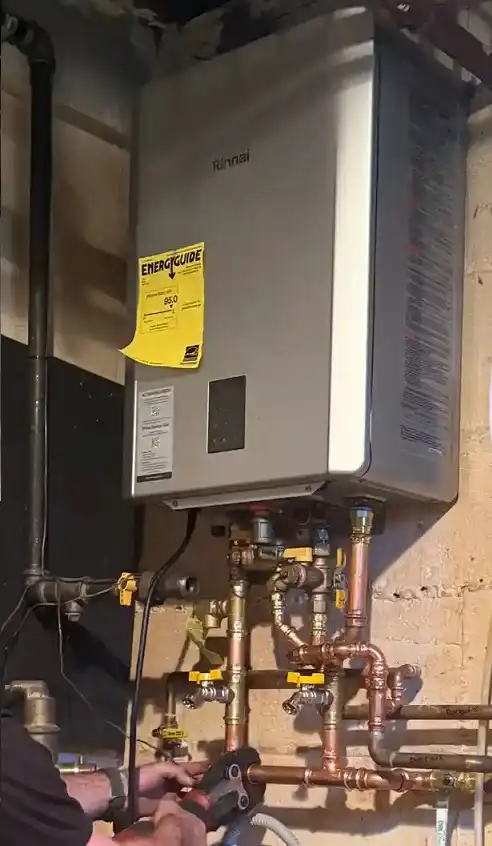
Rinnai combi boiler installation in Boston, MA with copper piping connections
Rinnai combi replacement in Somerville, MA by Boston Tank Swap.

Combi Boiler Installation Services

Replace an existing combi boiler

An aging or failing combi can be replaced with equipment matched to the home’s current needs. We review the existing gas supply, venting, water connections, heating zones, and controls rather than assuming they suit the new model. Compatible components may be retained; required changes belong in the written scope.

Convert a boiler and water heater to a combi

Combining two appliances can reclaim floor space, but the conversion involves more than mounting a unit. We assess hot-water demand, heating load, gas capacity, new venting, condensate drainage, and the changes needed to connect the heating and domestic-water systems separately.

Navien and Rinnai combi installation

Boston Tank Swap installs Navien and Rinnai combi systems. Model selection depends on heating requirements, usable hot-water output at the required temperature rise, installation constraints, and manufacturer requirements. We recommend equipment for the home rather than choosing by brand name or maximum input alone.

Is a Combi Boiler Right for Your Boston Home?

The best arrangement depends on how the household uses heat and hot water. A combi is an option to evaluate, not an automatic upgrade for every older boiler.

Worth considering when

  • The boiler and water heater are both approaching replacement.
  • Mechanical-room floor space is limited.
  • Simultaneous hot-water use fits the selected unit’s output.
  • Compatible hot-water radiators or baseboards can be served effectively.
  • Gas supply, approved venting, and condensate drainage can be provided.

A separate system may be more suitable when

  • Several showers or high-flow fixtures regularly operate together.
  • A large tub creates substantial peak hot-water demand.
  • The existing water heater is still useful and does not need replacement.
  • Small heating zones create a poor match for available minimum output.
  • Venting or utility constraints make a conversion impractical.

For storage-based hot water or a heating-only replacement, explore traditional boiler replacement and installation in Boston. An indirect tank may better suit some high-demand households.

Planning a Combi Conversion in Boston’s Older Homes

Small basements do not remove installation requirements

An older home in Dorchester or Roslindale may have limited basement space; a condo conversion in Brighton or Jamaica Plain may have a tight utility area. Wall mounting still requires suitable support, service clearances, approved intake and exhaust locations, and a way to manage condensate. Existing masonry-chimney venting is not automatically reusable.

Hot-water capacity matters in winter

Cold incoming water increases the temperature rise needed at a shower or faucet. Equipment selection should use the manufacturer’s output at that temperature rise, not just a headline flow rate. We consider concurrent use and explain when storage or separate equipment makes more sense.

Heating zones need their own assessment

A renovated West Roxbury house or multi-zone South Boston property may have heating demand very different from the original installation. Controls, circulators, water temperatures, and small-zone loads influence how a combi operates. The domestic hot-water input rating is not a substitute for heating-load assessment.

Shared buildings require clear scope

In a triple-decker or condo, identify which dwelling and fixtures the system serves. Shared gas infrastructure, vent routes, and common mechanical areas can affect the plan. A single residential combi should not be assumed suitable for an entire multi-family building without assessing demand and connections.

Our Combi Boiler Installation Process

  1. 01

    Assess both systems

    Review the current boiler and water heater, hot-water use, heating zones, equipment access, gas supply, and venting options.

  2. 02

    Size for heating and hot water

    Evaluate the home’s heating demand and simultaneous fixture use. Check domestic-water output under expected cold-water conditions and suitability for small heating zones.

  3. 03

    Explain the written scope

    Set out equipment, removal work, piping changes, venting, condensate handling, and installation costs. Discuss any existing components that need attention.

  4. 04

    Install and coordinate requirements

    Complete the agreed installation and coordinate applicable local permits and required inspections. Startup and inspection scheduling follow the project’s requirements.

  5. 05

    Start up and test

    Follow applicable manufacturer commissioning requirements, check controls and heating zones, and verify heating and domestic hot-water operation. Review operation with the homeowner.

Combi Boiler Installation: Estimate Your Project Scope

Boston Tank Swap’s 2026 estimated installed ranges are $9,000–$10,500 for an existing combi replacement and $12,500–$15,500 for a boiler-and-water-heater conversion. These are planning estimates, not guaranteed quotes. Gas upgrades, new venting, piping changes, equipment selection, and access affect the written estimate.

See the complete Boston boiler replacement cost guide

Licensed, Local Installation with Clear Recommendations

Boston Tank Swap is based in Newton and serves Boston and Greater Boston. Massachusetts Master Plumber Lic. #16763-PL-M and Plumbing Business Lic. #9629366-PL-C back the business. Our recommendations consider heating-system compatibility, hot-water demand, and the work needed for a professional installation, not simply whether a wall-mounted unit can fit.

Boston & nearby communities

We assess combi replacements and conversions for Boston homeowners and nearby communities. Explore the existing local service pages for more area information.

Combi Boiler Installation FAQs

What is a combi boiler?

A combi boiler supplies space heating and domestic hot water from a single appliance. Its heating circuit serves compatible hot-water radiators or baseboards, while domestic water is heated through a separate circuit. Unlike a conventional boiler paired with an indirect storage tank, a typical combi produces domestic hot water on demand. Capacity must be assessed for both uses.

Can a combi replace my old boiler and water heater?

Often, but not in every home. We assess heating demand, simultaneous hot-water use, gas capacity, piping, venting, and available space before recommending a conversion. Existing hot-water heating distribution may be retained with suitable connections. Steam heating needs a different assessment: a hot-water combi is not a direct replacement for a steam boiler.

Will a combi supply enough hot water for multiple bathrooms?

Bathroom count alone does not determine suitability. The key is how many fixtures run together, their flow rates, and the temperature rise needed from incoming cold water. Boston-area winter inlet temperatures can reduce available output compared with warmer conditions. Households with high simultaneous demand may be better served by a separate water heater or indirect storage system.

Do you install Navien and Rinnai combi boilers in Boston?

Yes. Boston Tank Swap installs Navien and Rinnai combi boiler systems in Boston and Greater Boston. The recommendation depends on heating load, domestic hot-water needs, gas supply, venting, and manufacturer installation requirements. We do not assume that the largest model is the best match or that one brand suits every property.

Can a combi work with my radiators, baseboards, and heating zones?

A combi can serve compatible hot-water radiators or baseboards, but the piping, circulation, controls, and operating temperatures need evaluation. Small zones also matter because the boiler’s minimum heating output affects cycling. Existing zone components may need modifications. Steam radiators are not assumed compatible with a hot-water combi installation.

How much does combi boiler installation cost in Boston?

Boston Tank Swap’s 2026 planning estimates are $9,000–$10,500 for an existing combi replacement and $12,500–$15,500 for a boiler-and-water-heater conversion. These are not guaranteed quotes. Compatible connections, equipment choice, piping changes, gas supply, venting, and access affect the final estimate. The complete boiler cost guide provides more detail.

How long does a combi boiler installation take?

A straightforward existing-system replacement may take about one to two working days, but this is not a guaranteed timeline. Converting two appliances to one, upgrading gas piping, installing new venting, or resolving access constraints can take longer. Equipment availability and permit or inspection scheduling also matter. Timing is discussed with the installation scope.

Can I start with a photo estimate?

Yes. Text photos of the existing boiler, water heater, piping, and venting to (617) 849-9929, or submit an online estimate request. Include your town and whether you want to replace an existing combi or combine two systems. Photos help begin the assessment; final sizing and installation scope may require an on-site review.

Explore a Combi Boiler for Your Boston Home

Send photos of your current boiler, water heater, and connections. Tell us whether you’re replacing a combi or considering a conversion, and we’ll help you understand the next steps.

Request your free estimate online