
Boiler Replacement & Installation in Boston
We replace and install boilers and combi systems across Boston with fast turnaround and clean, code-compliant work. Send a photo for a quick estimate and get your heat back without delays.
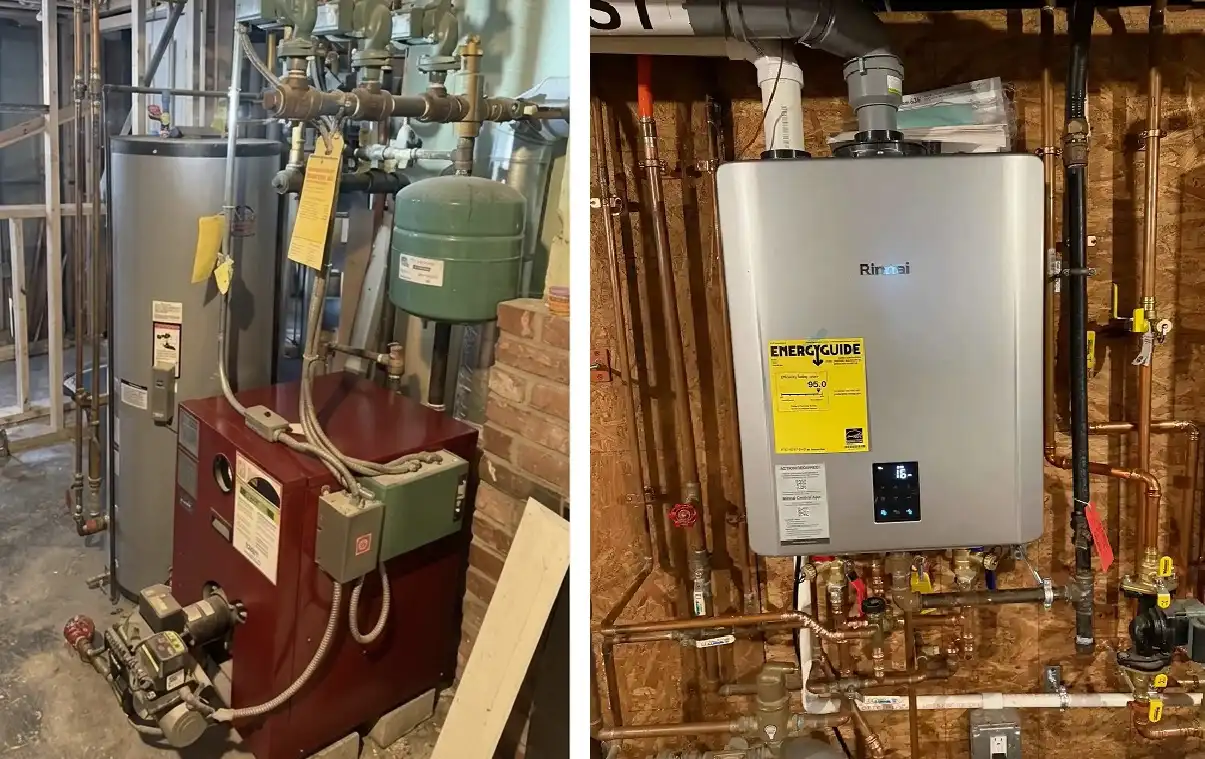
Boiler Replacement in Boston
Most homes in Greater Boston rely on hydronic heating. Hot water circulates through baseboard radiators, cast iron radiators, or radiant floor loops to keep the house warm during the long heating season. The boiler is the heart of that system, and when it starts to decline, the effects show up throughout the entire home.
Older cast iron boilers that were installed 20 or 30 years ago are still running in many local homes. Some of these systems are remarkably durable, but efficiency drops over time. A boiler that originally operated at 80% efficiency may now be running closer to 70% or less, which translates directly into higher gas bills every winter. Parts become harder to source. Repair visits become more frequent. At a certain point, the cost of keeping an aging boiler running exceeds the cost of replacing it with modern equipment.
Common reasons homeowners in our service area decide to replace their boiler include rising energy costs that do not match their usage, uneven heating where some rooms stay cold while others are too warm, frequent breakdowns during the coldest months, and visible signs of deterioration such as corrosion, leaks at fittings, or a cracked heat exchanger. Homeowners dealing with these issues often start looking into boiler replacement in Cambridge and nearby towns throughout Greater Boston once repairs become less reliable.
Modern high-efficiency boilers operate at 95% efficiency or higher. That means nearly all the energy from the gas you pay for actually goes toward heating your home. For a household that spends $2,500 or more on heating each winter, the difference between a 70% efficient system and a 95% efficient system adds up quickly.
Combi Boiler Installation in Boston
A combi boiler is a single wall-mounted unit that provides both space heating and domestic hot water. Instead of maintaining a separate boiler for heat and a separate water heater or indirect tank for hot water, a combi system handles everything from one compact piece of equipment.
For many Boston-area homes, this is a practical upgrade. Older mechanical rooms often have a boiler, an indirect water heater, an expansion tank, and a tangle of piping that takes up significant floor space. Replacing all of that with a single wall-mounted combi boiler opens up usable square footage and simplifies the mechanical system dramatically.
Combi boilers are especially popular in condos, townhomes, and smaller single-family homes where space is limited. They also make sense in situations where the existing water heater and boiler are both aging and due for replacement around the same time. Rather than replacing two separate pieces of equipment, a combi system consolidates everything into one installation.
The heating side of a combi boiler works just like a traditional boiler, circulating hot water through your baseboards or radiators. When a hot water tap is opened anywhere in the house, the unit detects the flow and prioritizes domestic hot water production. Modern combi boilers switch between heating and hot water modes seamlessly, and most homeowners never notice the transition.
Advantages of Combi Boilers
- Provides heating and hot water from one unit
- Wall-mounted design saves significant floor space
- High-efficiency condensing operation (95%+ AFUE)
- Eliminates the need for a separate water heater or indirect tank
- Fewer components means simpler maintenance
- Ideal for condos, townhomes, and smaller homes
When a Combi May Not Be the Best Fit
- Large homes with four or more bathrooms running simultaneously
- Households with very high peak hot water demand
- Homes with radiant floor heating requiring lower water temperatures
- Situations where existing indirect tank performance is excellent
- Properties with long pipe runs from the mechanical room to fixtures
Navien Combi Boiler Systems
Navien is the brand we install most frequently for combi boiler projects in our service area, alongside Rinnai combi units which we also install regularly. The Navien NCB series has earned a strong reputation among plumbers and homeowners for reliable performance, efficient operation, and solid domestic hot water output. These are not entry-level units. Both Navien and Rinnai build professional-grade equipment designed for real-world residential heating loads.
One of the reasons Navien combi boilers perform well in Greater Boston is their ability to handle cold incoming water temperatures without sacrificing hot water flow. During winter months, incoming water in this region can drop to the low 40s. Navien systems are engineered to deliver consistent hot water output even under those conditions, which is something that separates them from less capable equipment.
All Navien combi boilers use condensing technology, which extracts additional heat from exhaust gases that would otherwise be wasted. This is what allows them to achieve efficiency ratings of 95% or higher. The condensing design also means they can be vented with PVC, which simplifies installation and reduces material costs compared to stainless steel venting.
Navien NCB-190
120,000 BTUWell suited for smaller homes, condos, and single-bathroom setups where space is at a premium. Delivers solid heating performance with enough domestic hot water capacity for everyday household use.
Navien NCB-210
150,000 BTUThe most commonly installed model in our service area. Provides a strong balance of heating capacity and domestic hot water flow, making it a reliable choice for typical two to three bathroom homes across Greater Boston.
Navien NCB-240
199,900 BTUBuilt for larger homes with higher heating loads or greater hot water demand. Handles multiple bathrooms and simultaneous fixtures without sacrificing comfort or performance during peak usage.
Boiler vs Tankless Water Heater
This is one of the most common points of confusion we encounter with homeowners, and it makes sense. Both boilers and tankless water heaters are wall-mounted, gas-fired units that heat water. They look similar from the outside. But they serve different purposes and are not interchangeable.
A boiler heats water that circulates through your heating system. That water flows through baseboard radiators, cast iron radiators, or radiant floor tubing to warm your home. The water in a boiler loop is recirculated continuously and does not come out of your faucets. A boiler is part of your home heating system.
A tankless water heater heats fresh water on demand for domestic use. When you open a hot water tap, cold water enters the unit, gets heated, and flows out to your shower, sink, or dishwasher. Tankless water heaters have nothing to do with your home heating system.
A combi boiler bridges both worlds. It functions as a boiler for your heating system and switches to domestic hot water mode when a tap is opened. If your home currently has both a boiler and a separate water heater, a combi system may allow you to replace both with one unit.
Boiler / Combi Boiler
- Provides space heating through radiators or baseboards
- Combi models also produce domestic hot water
- Connected to your home heating distribution system
- Sized based on home heating load (BTU calculation)
Tankless Water Heater
- Provides domestic hot water only (showers, sinks, appliances)
- No connection to your heating system
- Sized based on flow rate (GPM) and temperature rise
- Replaces a traditional hot water tank
Related Services
If your home needs a dedicated hot water solution rather than a boiler, explore our water heater replacement services covering tank, heat pump, and indirect systems.
For homes looking to upgrade from a tank to on-demand hot water, see our tankless water heater installation page for detailed sizing and installation guidance.
High-Efficiency Boiler Benefits for Boston Homes
The heating season in Greater Boston typically runs from October through April, and in colder years it stretches into May. That is six to seven months of your boiler running daily. The efficiency of that boiler has a direct impact on what you spend on gas every year.
Older boilers, especially cast iron atmospheric units, typically operate in the 78% to 82% AFUE range. That means 18 to 22 cents of every dollar you spend on gas goes up the chimney as wasted heat. A modern condensing boiler operating at 95% AFUE captures most of that waste, turning nearly all of the fuel into usable heat for your home.
Beyond efficiency, newer boilers offer modulating burners that adjust output to match the actual heating demand. Instead of firing at full capacity and cycling on and off, a modulating boiler ramps up or down as needed. This results in more consistent room temperatures, quieter operation, and less wear on the equipment over time.
Lower Heating Bills
Condensing boilers extract more heat from the same amount of gas. The savings are most noticeable in homes that currently run older, less efficient equipment through the full Greater Boston heating season.
Consistent Comfort
Modulating burners match the heating output to the actual demand in your home. This eliminates the temperature swings common with older fixed-output boilers that cycle between full fire and off.
Compact Footprint
Wall-mounted boilers and combi systems free up floor space in your basement or utility room. This is particularly valuable in older Boston homes where mechanical rooms are already tight.
Our Boiler Installation Process
Every boiler installation follows a structured process designed to ensure the right system is selected, installed correctly, and fully permitted. Here is what to expect when you work with Boston Tank Swap.
System Assessment
We evaluate your current heating setup, measure the heat load for your home, assess the existing piping and venting, and determine whether a standard boiler or combi system is the right fit.
Equipment Selection
Based on the assessment, we recommend a system sized to match your home. This includes selecting the correct BTU output, confirming gas supply adequacy, and planning the venting route.
Removal of Old Equipment
The existing boiler or heating equipment is disconnected, drained, and removed from the premises. We handle disposal so there is nothing left for you to deal with.
Installation and Piping
The new boiler is mounted and connected to the heating distribution system, gas supply, and venting. All connections are made with proper materials and tested for integrity before the system is fired.
Permits and Inspection
We pull the required permits and coordinate the gas inspection. The local inspector verifies that the installation meets Massachusetts code requirements before the job is considered complete.
System Startup and Testing
The boiler is started, calibrated, and tested across all zones. We verify proper operation, check for leaks, confirm adequate heat output, and walk you through the basic system controls.
Signs Your Boiler Needs Replacement
Boilers are built to last, but they do not last forever. Knowing when to stop repairing and start planning a replacement can save you money and prevent a mid-winter breakdown.
Frequent Breakdowns
If your boiler has needed multiple service calls in the past two heating seasons, the cost of continued repairs may exceed the value of the remaining equipment life.
Uneven Heating
Rooms that are too hot or too cold despite bleeding radiators and adjusting thermostats often indicate a boiler that can no longer maintain proper output across all zones.
Rising Gas Bills
If your heating costs are climbing year over year without a corresponding increase in usage, declining boiler efficiency is a likely culprit. Older systems lose efficiency gradually as components wear.
Visible Corrosion or Leaks
Rust on the boiler body, corrosion at pipe connections, or water stains beneath the unit are signs of deterioration that will only get worse over time.
System Age Over 15 Years
Most residential boilers have a practical lifespan of 15 to 25 years depending on the type and maintenance history. Once a boiler passes the 15-year mark, the probability of significant failure increases.
Unusual Noises
Banging, kettling, or persistent rumbling from the boiler often indicates mineral buildup, failing components, or circulation problems that may not be worth repairing on older equipment.
Additional Resources
For detailed boiler pricing, see our boiler replacement cost guide for Boston.
For typical pricing on water heater systems, see our water heater replacement cost guide.
Already have a tankless system that needs service? Learn about our tankless maintenance and descaling services.
Not Sure How Old Your Water Heater Is?
Use our free age checker tool to find out the age of your water heater and check if the warranty is still active.
Check Your Water Heater Warranty & AgeWondering what a new boiler costs? We put together a detailed breakdown of boiler and combi boiler replacement pricing for the Greater Boston area, including what affects the final cost. Boiler replacement costs in Boston →
Frequently Asked Questions
What is the difference between a boiler and a water heater?
A boiler heats water to provide space heating through radiators, baseboards, or radiant floor systems. A water heater heats water for domestic use such as showers, sinks, and appliances. Some homes have both. A combi boiler combines both functions into a single unit, providing space heating and domestic hot water from one system.
What is a combi boiler and is it a good fit for my home?
A combi boiler is a wall-mounted system that heats water for both your heating system and your faucets. It eliminates the need for a separate hot water tank. Combi boilers work well in condos, smaller homes, and situations where space is limited. For larger homes with high hot water demand across multiple bathrooms, a traditional boiler paired with an indirect tank may be the better option.
How long does a boiler installation take?
A straightforward boiler replacement where the new unit goes in the same location typically takes one day. Combi boiler installations or projects that require new gas piping, venting modifications, or system reconfiguration may take longer depending on the scope of work involved.
Do you handle permits and inspections for boiler installations?
Yes. Every boiler installation we perform includes permit coordination and scheduling the required inspection with the local gas inspector. This is a standard part of our process for all gas-fired equipment installations in Massachusetts.
How do I know if my boiler needs to be replaced?
Common signs include frequent breakdowns, uneven heating throughout the house, rising gas bills, visible corrosion on the boiler or piping, and the system being over 15 to 20 years old. If your boiler is requiring repeated service calls or struggling to maintain comfortable temperatures, replacement is usually the more practical path forward.
Can you convert my old boiler system to a combi boiler?
In many cases, yes. Converting from an older boiler and indirect tank setup to a combi boiler can free up significant space and simplify the mechanical system. The feasibility depends on your home heating load, the number of bathrooms, and the existing piping and venting configuration. We evaluate all of this during the consultation.
What brands of boilers do you install?
We primarily install Navien and Rinnai combi boiler systems, which are among the most reliable and efficient units available for residential applications. Navien NCB series and Rinnai combi units are our most frequently installed models across Greater Boston. We also work with other high-efficiency boiler brands depending on the specific needs of the project.
Is a high-efficiency boiler worth the investment?
High-efficiency condensing boilers operate at 95% efficiency or higher, compared to 80% or less for many older systems. The difference shows up directly in your heating bills. For homes in Greater Boston where the heating season runs six months or more, the energy savings are meaningful and the equipment typically pays for itself over time.
Ready to Upgrade Your Heating System?
Contact Boston Tank Swap for a professional boiler or combi boiler installation consultation.