
Is a Tankless Water Heater Right for Your Home?
Tankless water heaters are a great option for some homes, but they're not always the right fit. If you're deciding between a traditional tank system and a tankless upgrade, here's what to know before making the switch.
How Tankless Water Heaters Work
When you open a hot water tap, cold water enters the tankless unit and passes over a flow sensor. This sensor triggers the burner (gas) or heating element (electric), which heats a compact heat exchanger. Water flowing through the exchanger absorbs heat and exits at the set temperature—all within seconds, without storing a single gallon.
Because there is no storage tank, there are no standby energy losses—the energy wasted keeping 40 or 50 gallons hot around the clock. The system only fires when hot water is actually being used, which is the primary reason tankless units are more energy-efficient than traditional tank heaters.
However, tankless performance is not unlimited. Output depends on two factors: the flow rate your household demands (measured in gallons per minute) and the temperature rise required to bring incoming cold water up to the desired output temperature.
Key concept: Tankless performance is determined by simultaneous flow rate (GPM) and the required temperature rise.
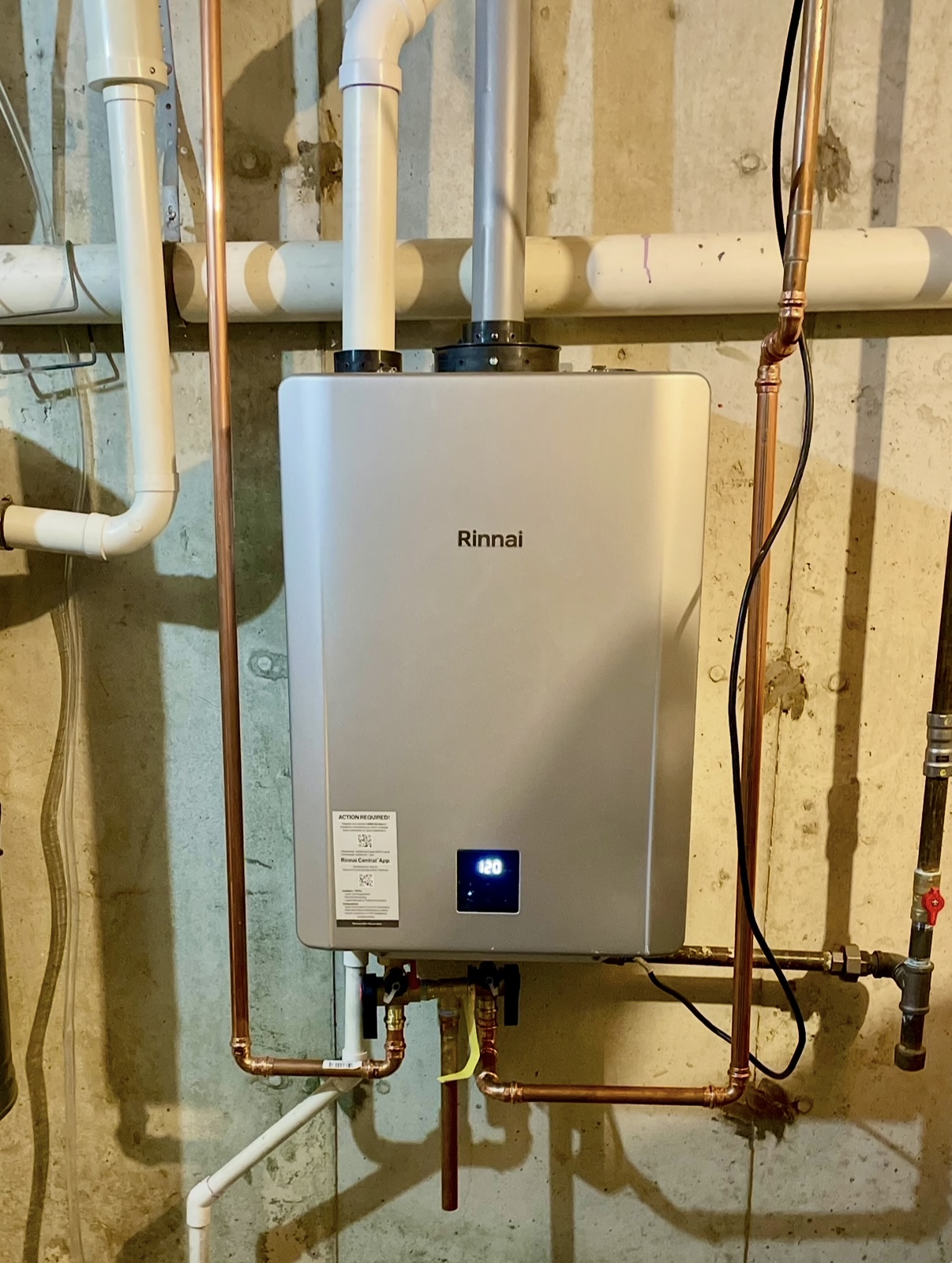
Benefits of Going Tankless
Tankless systems are a strong fit when you want higher efficiency, space savings, and longer service life—especially when the unit is properly sized, vented, and supplied with adequate gas or electrical capacity.
Endless Hot Water
On-demand heating delivers a continuous supply—ideal for busy households, back-to-back showers, and homes with in-law suites or multiple bathrooms.
Energy Efficient
Eliminates standby heat losses by only heating water when a tap is open, reducing energy consumption compared to tank systems that maintain temperature continuously.
Space-Saving Design
Compact wall-mounted units free up floor space—well suited for basements, utility closets, and tight mechanical rooms where a tank would be difficult to fit.
Professional Installation
Licensed, insured plumbers handle gas, venting, electrical, and condensate—installed cleanly, efficiently, and to code from start to finish.
When Tankless Might NOT Be the Best Fit
- Existing gas line is undersized and upgrading is impractical or cost-prohibitive
- Venting constraints make proper exhaust routing difficult in the available space
- Very hard water without a treatment plan increases scale buildup and maintenance burden
- Extremely high simultaneous demand without recirculation planning may cause flow limitations
- Tight retrofit locations where mounting, piping, and venting access are severely limited
- Budget constraints where the lower upfront cost of a tank system is a better short-term fit
Tankless Water Heater Sizing (GPM + Temperature Rise)
Sizing a tankless unit starts with understanding simultaneous usage—how many fixtures will run hot water at the same time. Running two showers plus a kitchen faucet at once requires more capacity than a single shower alone.
The second factor is temperature rise: the difference between the incoming cold water temperature and the desired output. In colder climates, incoming water can be 40–50°F, meaning the unit must raise the temperature 60–70°F or more to deliver comfortable hot water. This rise directly affects how many GPM the unit can handle.
For example, a household that runs two showers (each at 2.0 GPM) and a kitchen faucet (1.5 GPM) simultaneously needs a unit capable of at least 5.5 GPM at the required temperature rise.
Common Fixtures and Typical Flow Ranges
Sizing is not just about total GPM—cold incoming water temperature and simultaneous demand together determine the required heating capacity.
Condensing vs Non-Condensing Tankless Units
Condensing
- Higher efficiency—captures additional heat from exhaust gases through a secondary heat exchanger
- Cooler exhaust allows venting with PVC or polypropylene in many installations
- Requires a condensate drain—acidic condensate must be properly routed and may require a neutralizer
- Typically best for new installations or when maximizing long-term energy savings is a priority
Non-Condensing
- Lower upfront cost with proven, reliable technology
- Requires higher-temperature rated venting material (typically stainless steel or Category III vent)
- No condensate drain needed, simplifying installation in some locations
- Often a practical choice for replacements where existing venting is already compatible
Installation Considerations That Matter
A tankless installation involves more than swapping one unit for another. Several site-specific factors determine whether the installation will perform safely and efficiently over its full lifespan.
Gas Supply & Pipe Sizing
Tankless units require adequate BTU capacity at the point of connection. If the existing gas line is undersized or the run from the meter is long, a larger diameter pipe may be needed. Both pressure and volume must support the unit's demand without starving other appliances.
Venting & Combustion Air
Proper vent category and material are critical for safety. Condensing units typically use PVC or polypropylene; non-condensing units require higher-temperature rated materials. Intake and exhaust routing must meet clearance and termination requirements, and adequate combustion air must be available.
Condensate Drainage
Condensing tankless units produce acidic condensate that must be routed to an appropriate drain. In some installations, a condensate neutralizer is recommended to protect drain piping and meet local requirements.
Electrical & Controls
Most gas tankless units require a dedicated electrical outlet for the control board, ignition, and fan. Surge protection is worth considering. Some units support external controllers, recirculation pumps, or smart home integration through additional wiring.
Water Quality & Scale
Hard water causes mineral scale to build up inside the heat exchanger over time, reducing efficiency and restricting flow. In areas with hard water, a treatment plan or more frequent descaling helps protect the unit's performance and longevity.
Maintenance, Descaling, and Long-Term Reliability
Even in areas with moderate water hardness, minerals gradually deposit inside the heat exchanger. Over time, this scale restricts water flow, reduces heat transfer efficiency, and can trigger error codes or premature component wear.
Descaling—flushing the heat exchanger with a mild descaling solution—is the single most important maintenance task for a tankless unit. Most manufacturers recommend it annually, and more frequently in hard water areas. Following the manufacturer's maintenance schedule helps preserve efficiency and warranty coverage.
Signs that maintenance may be needed include reduced hot water flow, temperature fluctuations during use, longer delays before hot water arrives, or error codes on the unit's display. Learn more about what's involved and when to book on our tankless water heater maintenance page.
Maintenance Checklist
- Clean the inlet water filter
- Flush and descale the heat exchanger as recommended
- Visually check the vent termination for obstructions
- Keep the area around the unit clear for airflow (if applicable)
Our Tankless Replacement & Installation Process
Demand Assessment
We evaluate your household's simultaneous fixture usage and daily hot water patterns to determine the right capacity.
Site Evaluation
We inspect your gas or electrical supply, venting path, condensate drainage options, and mounting location.
Right-Size Recommendation
Based on required GPM and temperature rise, we recommend the appropriate unit and configuration for your home.
Transparent Quote & Scheduling
You receive a clear, itemized quote. Once approved, we schedule installation at a time that works for you.
Professional Installation
Licensed plumbers handle all water, gas or electrical, venting, and condensate connections to code.
Commissioning & Walkthrough
We test the system, adjust settings, review maintenance guidance, and provide warranty registration information.
Tankless vs Tank Water Heaters
If you learn more about traditional water heaters click here.
Trusted Tankless Brands We Install
- Navien — High-efficiency condensing technology with built-in recirculation options. Known for reliable controls, quiet operation, and strong manufacturer support.
- Noritz — Durable, serviceable designs engineered for longevity. Proven track record in residential and light commercial applications with accessible components for maintenance.
- Rinnai — Premium performance with robust warranty coverage. Advanced digital controls, Wi-Fi connectivity options, and a wide range of models for different demand levels.
For typical tankless installation pricing, see our tankless water heater cost in Boston guide.
Not Sure How Old Your Water Heater Is?
Use our free age checker tool to find out the age of your water heater and check if the warranty is still active.
Check Your Water Heater Warranty & AgeFrequently Asked Questions
What size tankless water heater do I need?
Tankless units are sized by flow rate (GPM) and temperature rise. You need to determine how many fixtures will run simultaneously and the difference between your incoming cold water temperature and desired output. Most homes require a unit capable of 5–10 GPM depending on demand and climate.
Can a tankless water heater run two showers at once?
Yes, provided the unit is properly sized. Two showers typically require 3–5 GPM total. In colder climates where temperature rise is greater, a higher-capacity unit or a condensing model may be needed to maintain comfortable output across multiple fixtures simultaneously.
Can I convert from a tank water heater to tankless?
Yes. Converting from tank to tankless is one of our most common projects. The conversion may involve upgrading the gas line, adding appropriate venting, running a condensate drain (for condensing units), and ensuring adequate electrical supply for the control board.
Condensing vs non-condensing: which is better for my home?
Condensing units are more efficient and allow PVC venting, but require a condensate drain. Non-condensing units cost less upfront and skip the condensate drain, but need higher-temperature rated venting. The best choice depends on your installation site, budget, and long-term efficiency goals.
Do tankless water heaters work well in cold climates?
Yes, but cold incoming water increases the temperature rise the unit must produce, which reduces the effective flow rate. Proper sizing that accounts for winter inlet temperatures is essential. High-capacity condensing units are often the best fit for cold-climate installations.
Do tankless units require annual maintenance?
Most manufacturers recommend annual descaling to remove mineral buildup from the heat exchanger, especially in hard water areas. Regular maintenance preserves efficiency, prevents error codes, and helps protect warranty coverage. Cleaning the inlet filter and checking the vent termination are also recommended.
How long do tankless water heaters last?
Tankless water heaters typically last 15 to 20 years or more with proper maintenance, compared to 8–12 years for standard tank water heaters. Key factors include water quality, usage patterns, and adherence to the manufacturer’s maintenance schedule.
Will I need a gas line upgrade for a tankless water heater?
Possibly. Tankless units require a higher BTU input than most tank water heaters. If the existing gas line is undersized or the run from the meter is long, a larger diameter pipe may be needed to supply adequate volume and pressure without affecting other gas appliances.
What venting is required for a tankless water heater?
Condensing tankless units typically use PVC or polypropylene venting due to their cooler exhaust temperatures. Non-condensing units require higher-temperature rated materials such as stainless steel or Category III vent pipe. Both types need proper intake and exhaust routing with correct termination clearances.
Why does my tankless water heater take time to deliver hot water?
The delay is usually caused by the distance between the unit and the fixture—water sitting in the pipes between the two has cooled. A recirculation system can minimize this wait by keeping hot water closer to the point of use. The tankless unit itself heats water almost instantly once flow is detected.
Need a heating system for your home? Explore our boiler & combi boiler installation. Combi boilers provide both space heating and hot water in one unit.
Ready for a Tankless Upgrade?
Get a professional tankless water heater installation from Boston Tank Swap.